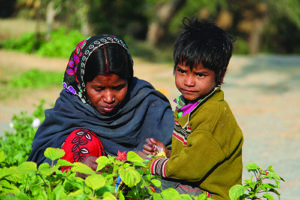
 My sister is ten years old. Every morning at seven she goes to the bonded labour man, and every night at eight she comes home. He treats her badly and hits her mercilessly if he thinks she is working slowly. He also yells at her if she talks to other children while at work. He comes looking for her if she is sick and cannot go to work. I feel this is very difficult for her. I do not care about school or playing. All I want is to bring my sister home from the bonded labour man. For 600 Rupees I can bring her home that is our only chance to get her back. We don’t have 600 rupees. We will never have 600 rupees”
Binu, 8 years old, for her sister Laxmi.
This is the true story of Laxmi, a bonded child labourer at a local cigarette rolling factory and one amongst millions of children in India, left to endure the worst forms of child labour at a very early age.
Worldwide perspective
It is difficult to know exactly how many children through out the world are employed in some form of economic activity. The latest estimates by the International LabourOrganisation or the ILO put the number of working children between the age group of 5 to 17 years old at 246 million.
Amongst them, 179 million children, one in every eight child in the world is still subjected to the worst forms of child labour which endangers his or her physical, mental and moral well being.
 The Indian Perspective
There are more children under the age of 14 years in India than the entire population of the United States.
According to the ‘Indian Census of 1991’, there are more than 11 million working children under the age group of fourteen years in India. Of these nine out of every ten children work in their own rural family setting.
The notion that children are being exploited and forced into labour, while not receiving education crucial to overall development of a child, concerns many people. India is the largest example of a nation plagued by the problems of child labour. Estimates cite figures between 13.6 to 14 million working children in India, the highest number in the world”[Human Rights watch 1996, 122].
Our Stand on child labour
India has all along followed a proactive policy in the matter of tackling the problem of child labour. India has always stood for constitutional, statutory and development measures that are required to eliminate child labour in India. The Indian Constitution consciously incorporated relevant provisions to secure compulsory elementary education as well as labour protection for children in India.
Non – government Organisations
Here the work of voluntary agencies should be taken into the reckoning too. For outside the public sphere,India contains some of the most forthright activist NGO’S anywhere in the world.Conducting a running commentary on government efforts,they have managed to keep the issue of child labour at the forefornt of both national and international attention, certainly over the last twelve years or so. The indian government has been forced to respond, the 1986 Act for instance, owed much to the pressure applied by the NGO concerned for working children in bangalore,which even went to the length of supplying a draft bill to the parliament.
All this ostensibley has been to little avail. While Japan , Taiwan and South korea by way of contrast, eradicated all signs of Child labour once they set out to do so,and the philippines, Indonesia and Thai land have made considerable progress in this direction India has yet to make a similar impression on the problem.
Child Labour was pervasive in 1919, it remains endemic in 2004.
The Indian context is not confined to human rights alone, but incorporates dimensions that go beyond this realm, even trancends it. These include the following:
Child labour laws in India
The present regime of laws relating to child labour in India have a pragmatic foundation and are consistent with the international labour conference resolution of 1979’.
The strategy of progressive elimi- nation of child labour underscores India’s legislative intent. The first “Act” in India relating to child labour was the Enactment of Children (pledging of labour) Act, 1933. Since then there have been nine different Indian legislations relating to child labour. Perhaps the most comprehensive step in the effective elimination of child labour in India has been the enactment of The Child labour (Prohibition and Regulation) Act,1986.
The policy of the Indian government is to ban employment of children below the age of 14 years, in factories, mines and hazardous employment and to regulate the working conditions of the children in other employment. The Child Labour (Prohibition and Regulation) Act, 1986, seeks to achieve this basic objective.
However, due to cultural and economic facts these goals remain difficult to meet. For instance, the Act does nothing to protect children who perform domestic or unreported labour, which is very common in India.
The Bonded Labour System Act, 1976, fulfills the Indian Constitutions directions of ending forced labour. The Act frees all bonded labourers, cancels any outstanding debts against them, prohibits the creation of new bonded labour in any form.
The main causes of child labour in India
l Poverty
l Absence of social welfare schemes and easy access to loans.
l Caste system (scheduled cast children are more prone to work as child labourers)
l Lack of access to schools.
l Attitude of poor parents (skills more important than education)
l Child labour is 80% cheaper.
How necessary is child labour to families in India
In India child labour is a source of income for poor families. A study conducted by the ILO, Bureau of Statistics, found that childrens’ work was considered essential in maintaining the economic levels of house holds, either in the form of working for wages or for freeing adult household members, thus allowing them to engage in other economic activities elsewhere. In some cases, the study found that a child’s income accounted between 34% to 37% of the total household income. This study concludes that a child labourer’s income is important to the livelihood of poor families. Child labour cannot be eliminated by focussing on one determinant alone, for example education, or by brute enforcement of child labour laws. The government of India must ensure that the needs of the poor are fulfilled before attacking childlabour. If poverty is addressed, the need for child labour will automatically diminish.
Child labour is a significant problem in India, the prevalence of it is shown by the child work participation rates which are higher in India than in any other developing country. Children are often exploited and deprived of their rights and until further measures are taken to stop this, many more Indian children will continue to get exploited in the worst manner possible.
So, let us do our bit to eradicate child labour completely from the face of this planet and gift a better tomorrow to the coming generations.
CASE STUDY
CHILD SERVENT SACRIFICED TO CORRECT VAASTU FLAWS
l Cyberland has once again shown that one of its legs is still in the stone age. In a grusome murder, a child was reportedly sacrificed in the near byMedak district for correcting certain Vaastu flaws.
l According to local reports, a businessman reportedly sacrificed Venkamma ,who was seven years old to propitiate the Vaastu gods for a flaw in his house in Patancheru the industrial hub of Hyderabad.
l With the discovery of the body of Venkamma from a septic tank close to the house of the businessman suspicion on how the little girl died has been doing the rounds.
l According to reports, Venkamma, was playing with other children when she attracted the attention of the wife of the businessman.
l For two days she did household work as a servant in the house of the businessman However, on the third day Venkamma went to work but never returned home.
l Venkamma’s parents and friends, after searching in vain for her for four days, lodged a complaint with the Patencheru police on Wednesday the day on which the body was recovered from the Septic tank.
l Enquires revealed that on December 15, when the businessman called some labourers to prepare a cement lid for an open septic tank in the vicinity of the house, some of the labours noticed the legs of a child protruding from the Septic tank when they pulled out the body, it was identified as that of Venkamma.
l Even as the police were dragging their feet in investigations initially the members of the businessman’s family reportedly bolted doors and filed Patencheru. Subsequently, when it became clear that the child might have been hired with an ulterior motive and done to death as alleged by some local people, the police registered a case against the businessman & his family.
l According to local belief , bad Vaastu could be converted in to good through human sacrifice.
l The historical Dimension – Child labour goes back a long way, it has a distinct and enduring rationale.
l The cultural dimension – Child labour is entwined in the caste system of India and the acceptance of inequality associated with this kind of social and economic stratification.
l The development dimension – Child labour relates to the structure of India’s economy.
-LAWZ BUREAU