National judicial commission – its pros and cons
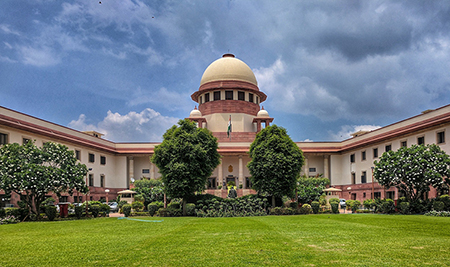 In any democratic set-up like ours, governed by the rule of law, judiciary has a special place. It is like the conscience in a man. Unseen, yet its presence is felt. Its role, which has given importance to it, is that of an arbiter of disputes between man and man, and man and state. The judge has a role in transforming people’s frustrations into a revolution of expectations of a humane tomorrow. The Indian Supreme Court is admittedly the most powerful judiciary in the world today. With power comes responsibility and the need to insulate it from corrupting influences both from within and from outside. Corruption no doubt is an inevitable aspect, which has crept into every field of public administration. Judiciary, though less in comparison to other branches is also affected.
Recently there has been much hue and cry over setting up of a National Judicial Commission, which will bring down the levels of corruption and aim for an effective judicial administration at the same time. National Committee On Judicial Accountability has showed its willingness to set up such commission, and they have also indicated that this commission would possess the supreme powers of appointment, transfer as well as the removal of the judges. Surely a body like that of National Judicial Commission (NJC) is needed to be established but with due care and caution.
The first and the foremost thing, which comes to my mind, is the manner of appointment of the members of commission. The person who is going to judge the judges himself should be one of the best in his kind. We cannot let simply anyone to go out and be a member of NJC. This indeed would be one of the most important body of its kind. Thus, the members should be of high moral character and should possess high esteem. It should also be made sure that the members are not biased, as well as their opinion is not politically motivated. Definitely if political ends influence the appointment of the members of NJC, it will hit the independence of judiciary and I am afraid, that day will be the black day for the judiciary. Independence of judiciary is the integral part of the democracy itself and that should remain always intact otherwise the consequences can be dangerous.
 The next thing in question is about the extent of powers vested with the NJC. The powers can be sub-divided into three categories, (a) power of appointment, (b) power of transfer and (c) power of removal. The existing provisions regarding the appointment of SC judges and the HC judges are stated in Art. 124(2) and Art. 217(1) in the Constitution respectively. At present there is a chance of a malafide appointment being made because the decision could be politically motivated. This can be recalled from the illustration wherein Indira Gandhi’s government, Justice Khanna was superseded to be the CJI. Thus, it is being put forth that NJC should recommend the names of judges to be appointed to the President who formally appoints the same.
The power of transfer of respective HC judges presently vests with the President who in consultation with the CJI exercises it. It has been provided in Art.222 (1) of the Constitution of India. The NJC can also be given the power to bring any such case in the knowledge of the government if some High Court judge is to be transferred on some allegations.
Now, comes the most disputed category of power of NJC, that is, removal of judges. Constitution establishes procedure of impeachment both for the SC as well as the HC judges. Well it is being said that the impeachment procedure for the removal of judges is most cumbersome and has lost effectiveness to eradicate the errant judges. Lot of debate is going on upon the matter that NJC should have the power to remove SC as well as HC judges.
As a matter of fact, Supreme Court is the sole guardian of the Constitution. What has been said by the Supreme Court in its judgments stands as the law of land. In other words, Supreme Court is supreme authority that nobody can challenge. The powers and functions of SC are derived from the Constitution itself. Now, in case, NJC has the power to remove the SC judge it will have three-fold impact.
Firstly, it will hit the independence of judiciary because it is not sure that political ends will not influence the members of NJC.
Secondly, another peculiar aspect relating to NJC is the necessity of constitutional amendment, which will be inevitable for the establishment of the said commission. According to article 368 of the Constitution, it can only be amended with due procedure. But in Keshavanand Bharti and Rajnarain case SC has held that article 368 was subject to the implied limitation that the power to amend could not alter ‘the basic features’ of the Constitution. What is basic feature has been left open for judicial review. In case if impeachment procedure is struck down, there is also a possibility of this being declared to be unconstitutional and to be further struck down by the SC.
Thirdly, SC has been decisive authority over everyone for more than half a decade. It has been milestone of justice to each one of us. Cases such as Best Bakery etc. restore pride to judiciary. In such scenario are we ready to find someone superintending the SC itself.
What if there is a deadlock between the Supreme Court and the NJC. I think that situation would be the toughest one to handle.
It has been felt that the corruption in the higher judiciary goes unnoticed and thus the setting up of NJC is being advocated. I feel that there is no guarantee that the members of NJC are not coloured or corrupt. After all they would be human beings just as the judges. There has to be some faith in someone. You have to believe somebody. There is a proverb that “the world stands on faith itself”. The judge has reached such stage of his career, and losing faith in him will depict an unhealthy and unethical aspect. I don’t say that the SC judges should be believed blindly. For them impeachment procedure should remain as a safety valve. The position of the Supreme Court judges is very delicate and they hold the post in very high esteem and it is felt that to a great extent they observe self-discipline. They themselves keep it in mind that they have some judicial accountability. They know that they have to face a long line of intelligent and senior most lawyers along with the eminent jurists of national and international fame. Even fair criticism indirectly controls their judicial performance to a great extent in the present justice delivery system. Mere proposal to impeach some SC judge, in itself has a very sharp edging impact on the stature of concerned judge, so there are least chances for SC judges to go beyond their limits. We may refer the case of Justice Ramaswamy, against whom the impeachment proceedings were initiated, but failed due to the division of the political opinion. Inspite of its failure it has an everlasting impact in the history of the functioning of judiciary. I am of firm view that psychologically this example casts an impression upon all members of judiciary that, the introduction of the proposal of impeachment itself in Parliament was a bad name upon the judge himself. Such examples also play an important role in providing some checks and balances to curb the possibilities of involvement of at least the SC judges in any such corruption.
It can also be suggested that while elevating some judge to the Supreme Court, NJC should be taken into confidence but after his elevation he should not be subjected to the superintendence of NJC so as to prevent the independence of judiciary from being at stake. Appointment of only those judges should be made to SC who have proved to be upright and have their career as white as milk.
Thus from the above observations and other thoughts I feel that the power of appointment, transfer and removal of judges of respective HC’s should be vested in NJC. The judges of SC should not be made answerable to NJC. The procedure of impeachment should be adopted only in case of SC judges, not in the case of judges of HC. This I say because of the fact that the chances of being erroneous, corrupt judge present in SC is far less than the chances of him being present in any of the HC. The total number of The Supreme Court judges amounts to 26 including the CJI whereas the total number of HC judges is more than 250 approximately.
The previous CJI, Justice V.N. Khare said in his tenure that it is high time that the CJI should be given the powers to control the errant and undisciplined judges. If NJC is established then there is no point of the same powers being given to the CJI. There should be a balance in the distribution of powers, which is very necessary for an effective administration.
There is no doubt that NJC should possess such disciplinary powers so as to bring errant and corrupt judges on track. This is the basic aim for which it is being established. It should be known that the real source of strength of the judiciary lies in the public confidence in the institution. It is thus, imperative, that transparency should be increased along with the bodies like NJC controlling the indisciplined judges. Nevertheless, one thing could be said that, no doubt NJC would discipline judges but until and unless judges follow the theory of self-restraint, nothing is possible. The onus lies upon them primarily to restore pride and faith in the institution.
It is thus said that National Judicial Commission should be established but the framework should be such that it does not hit the independence of judiciary nor does it bring into being more corruption. It should be made sure before establishing it that it does what it has to do. There is a rule of democracy- “there is everyone over everyone”. This means nobody is supreme except the Constitution. If you are superintending someone there must be somebody who should be superintending you. If NJC is established along with all the safety valves then only we can hope for efficient and effective judicial administration at all levels.
I feel that there is no guarantee that the members of NJC are not coloured or corrupt. After all they would be human beings just as the judges. There has to be some faith in someone. You have to believe somebody.
Even fair criticism indirectly controls their judicial performance to a great extent in the present justice delivery system.
By LawZ Bureau