LOUIS DEMBITZ BRANDEIS
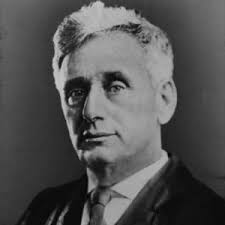 LOUIS DEMBITZ BRANDEIS (1856-1941), American jurist, one of the most famous justices of the United States Supreme Court, was known for his liberal views and his dissenting opinions.
Brandeis was born in Louisville, Kentucky, on November 13, 1856, the son of a prosperous grain merchant. After attending public schools in Louisville he studied in Dresden, Germany. At the age of 18 he entered Harvard Law School and earned the highest average in the law school’s history, graduating in 1877.
From 1879 to 1916 he practiced law in Boston, achieving national prominence in many important cases. He distinguished himself by investigating insurance practices and by establishing the Massachusetts Savings Bank Insurance in 1907.
Brandeis was known as the people’s attorney as a result of his repeated and continued support of issues important to the general public.
In Muller v. Oregon 208 U.S. 412 (1908) he persuaded the U.S. Supreme Court that minimum-hours legislation for women was reasonable-and not unconstitutional-with a brief primarily consisting of statistical, sociological, economic, and physiological information. This “Brandeis Brief”, as it came to be called, revolutionized the practice of law.
As an arbitrator in 1910 of a strike of mostly Jewish New York garment workers, he became acutely aware of Jewish problems and afterward was a leader of the Zionist movement.
An enemy of industrial and financial monopoly, he formulated the economic doctrine of the New Freedom that Woodrow Wilson adopted in his 1912 presidential campaign.
In 1916,over the protests of the vested interests and opposition from anti-semites that Brandeis had alienated as the “people’s attorney”, Wilson appointed him to the U.S. Supreme Court.
From 1916-1939 he remained an Associate Justice of the U.S. Supreme Court. Justice Louis D. Brandeis, who had been a brilliant attorney, had no previous judicial experience before being named to the United States Supreme Court. He was also the first Jewish member of the United States Supreme Court.
Justice Brandeis is generally regarded as a great thinker and a judicial pioneer.
Long an advocate of social and economic reforms, he maintained a position of judicial liberalism on the bench. Together with Oliver Wendell Holmes he often dissented from the majority. In1933, when Franklin Delano Roosevelt became President, Brandeis was one of the few justices who voted to uphold most of Roosevelt’s New Deal legislation.
For Brandeis, law was a device to shape social, economic, and political affairs. Law had to operate on the basis of two key assumptions: that the individual was the basic force in society and that the individual had limited capabilities. Brandeis did not seek to coddle the individual; rather, he sought to stretch individual potential to its limit. It is difficult to isolate a single opinion among the hundreds that Brandeis wrote. However, the opinion with the greatest impact on the law must be the federalism case of Erie Railroad Co. v. Tompkins, 304 U.S. 64 (1938) , one of the last opinions Brandeis wrote. The important question whether the federal court was free to disregard the alleged rule of the Pennsylvania common law was decided by this case. The Court had to decide whether the principle introduced in Swift v. Tyson 41 U.S.1(1842), that federal courts exercising jurisdiction on the ground of diversity of citizenship need not, in matters of general jurisprudence, apply the unwritten law of the State as declared by its highest court; that they are free to exercise an independent judgment as to what the common law of the State is. The court declared that this principle should be applied carefully and be cautious of any discrimination resulting from the broad province accorded to the so-called “general law” as to which federal courts exercised an independent judgment.
Brandeis was also a prolific writer, and some of his writings are Other People’s Money (1914) and Business, a Profession (1914); The Social and Economic Views of Mr. Justice Brandeis (1930); The Curse of Bigness (1935); The Words of Justice Brandeis (1953).
He retired from the bench in 1939. Brandeis University is named after him. Justice Brandeis died on October 5,1941, leaving an indelible mark in the world of law.
By LawZ Bureau,