
Jean jacques rousseau
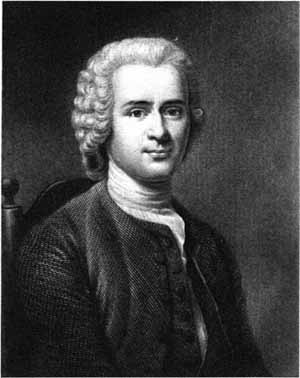 Jean-Jacques Rousseau was born on June 28, 1712 in Geneva, Switzerland. His mother died shortly after his birth. When Rousseau was ten his father fled from Geneva to avoid imprisonment for a minor offense, leaving young Jean-Jacques to be raised by an aunt and uncle. He left Geneva at sixteen, wandering from place to place, finally moving to Paris in 1742. He earned his living during this period, working as everything from footman to assistant to an ambassador. Rousseau’s profound insight can be found in almost every trace of modern philosophy today. Somewhat complicated and ambiguous, his general philosophy tried to grasp an emotional and passionate side of man which he felt was left out of most previous philosophical thinking. In his early writing, Rousseau contended that man is essentially good, a “noble savage” when in the “state of nature” (the state of all the other animals, and the condition man was in before the creation of civilization and society), and that good people are made unhappy and corrupted by their experiences in society. The eminent jurist viewed society as “artificial” and “corrupt” and that the furthering of society results in the continuing unhappiness of man. Rousseau’s essay, “Discourse on the Arts and Sciences”, argued that the advancement of art and science had not been beneficial to mankind. He proposed that the progress of knowledge had made governments more powerful, and crushed individual liberty. He concluded that material progress had actually undermined the possibility of sincere friendship, replacing it with jealousy, fear and suspicion. His most important work is “The Social Contract” that describes the relationship of man with society. Contrary to his earlier work, Rousseau claimed that the state of nature is brutish condition without law or morality, and that there are good men only a result of society’s presence.
He minimizes the importance of book learning, and recommends that a child’s emotions should be educated before his reason.
In the state of nature, man is prone to be in frequent competition with his fellow men. Because he can be more successful facing threats by joining with other men, he has the impetus to do so. He joins together with his fellow men to form the collective human presence known as “society.” “The Social Contract” is the “compact” agreed to among men that sets the conditions for membership in society. Rousseau was one of the first modern writers to seriously attack the institution of private property, and therefore is considered a forebear of modern Socialism and Communism. He also questioned the assumption that the will of the majority is always correct. He argued that the goal of government should be to secure freedom, equality, and justice for all within the state, regardless of the will of the majority. One of the primary principles of Rousseau’s political philosophy is that politics and morality should not be separated. When a state fails to act in a moral fashion, it ceases to function in the proper manner and ceases to exert genuine authority over the individual. The second important principle is freedom, which the state is created to preserve. Rousseau’s ideas about education have profoundly influenced modern educational theory. He minimizes the importance of book learning, and recommends that a child’s emotions should be educated before his reason. He placed a special emphasis on learning by experience.
-LawZ Bureau
Thanks for sharing
Good job,world
I like your site its well designed
Well written
Very informative