
Interviewing Justice Vijender Jain
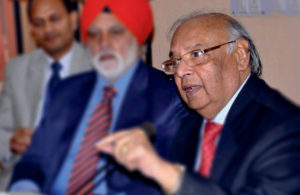 Always a rebel, and constantly in the eye of the storm, Justice Vijender Jain was the Acting Chief Justice of Delhi High Court and later was appointed as the 27th Chief Justice of Punjab and Haryana High Court. He is credited with taking Suo moto cognizance in the Jessica Lal Murder Case of the decision of the Lower Court, which had let off the main accused due to lack of evidence. His contribution towards cleaning of Yamuna can be traced to his directions for demolition of unauthorised structures and removal of encroachments from the bank of the river. Some of his notable intellectual property rights Judgements have been reported in Fleet Street Reports. Till recently, he headed the Haryana Human Rights Commission as its Chairperson. The LawZ Team on a pleasant afternoon, met him at his residence and chamber to discuss his views on legal matters.
How did you enter the legal profession. How did it all start
My maternal grandfather was a lawyer practicing in Hisar. He was a well-established lawyer. People use to wait in queues to see him. That’s was my first brush, after which, I decided that I wanted to do law instead of business.
Late V K Krishna Menon Former Defense Minister also inspired me to become a lawyer. Although, my father always thought, I would never become a successful lawyer because of my coming from a business background and not a legal background. Later however, he realized I was determined to be a lawyer. After that he fully supported me.
Particular branch of Law which is close to your heart
Broadly speaking, initially I was more into civil law but always had a deep interest in constitutional mechanism of the country. In college, I had secured the most marks in Constitutional Law. So Civil and Constitutional Law are both very close to my heart.
Where do you see the future of Arbitration as a means of resolving civil disputes
The current Justice dispension system in courts is unable to resolve the cases. There is high pendency so an alternate dispute resolution is a necessity. We need to look at new tools, strategy and vision to deal with this backlog of cases. More than 30 million cases are pending. On the other hand, there are so many vacant posts of Judges. The Public is the ultimate sufferer in this blame game between the government and judiciary. Current system of evaluation of Judges is also outdated. We have to make Judges conscious of the fact, that they need to deliver justice instead of seeing themselves as holding a good position in life. As a former Chief Justice, I know and can say, that the system in place needs a thorough reworking.
There is a sense, that Judges are not adequately compensated. So what do you think of the idea that Judges should be incentivized on the basis of number of cases they dispose
Call me conservative, but money should not be linked with disposal of cases. A person entering the Judiciary should not have money on his mind. That is the reason why Judges were always respected. In our country, where there is an ocean of poverty and some islands of affluence, I don’t think that the Judges should pursue personal economic goals. We must realize that, in our country 450 million people live below poverty line. Whereas, the perks and facilities to Judges are enough for a comfortable life. Independence of judiciary is paramount. It can be eroded, by linking it to economic and financial incentives.
Do you think there should be some time limit for pronouncing the judgment after reserving it
Yes, I think that there definitely should be, a defined time limit and the Judges should be held accountable on this count. Speedy disposal of cases is the need of the hour.
When a Judge recuses himself from a matter, should the reasons be disclosed
First of all, a Judge should be strong enough not to recuse himself and in my perspective, if he does so, he should record the reasons in writing. It is the constitutional duty of the Judge not to recuse himself and if there are really strong reasons for doing so, there should be full disclosure by the Judge.
Modern judicial thinking questions, as to why Taxpayer should bear the burden of two litigants warring amongst themselves on some private dispute between them
In larger societal interest one has to contribute and sacrifice for the harmony in the society. The Taxpayer should pay for Law, Legal Protection and Legal Services. In a way similar to, where the society pays for the police and fire department who services may ultimately be availed by only a few in society.
In our legal Educational system more and more students are opting for Corporate practice.
Incidentally, National law Schools were established under the patronage of the High Courts to improve the Advocacy skills of future lawyers, so that they could provide excellent assistance to the courts. Whereas, these schools are actually motivating law students more towards corporate practice. If you ask me, when you join a corporate entity you become a Law Assistant, and nothing more. Nobody can become a good lawyer if he has no exposure in Court. The fine tuning by a Judge can only be done in a court room.
Any Guru in the legal field
Late BC Misra, Judge High Court of Delhi. He was a truly remarkable person. After retirment, he relinquished all his wordly possessions and became a Sanyasi.
What made you give up your lucrative practice and become a Judge
I was a Senior Counsel, in the year 1992. I was doing very well. The then Chief Justice of the Punjab High Court called me and insisted that I should think about becoming a judge.
Post retirement, how did you take your new assignments
I’m a firm believer that retired Judges should not be immediately appointed. It goes against the principle of independence of judiciary. I assumed the office of Punjab Human Rights Commission after a four years gap. I thought I could do a good job of setting up the Human Rights Commission in the State.
People associate you with the ‘Diplomatic Passports for Judges’ case
A PIL was filed in the High Court as to why the Judges should not be issued Diplomatic Passports. It came to light that even Government Secretaries had diplomatic passports and Judges who held the constitutional positions were not being provided the same passports. We issued notice to the Government on it and the External Affairs Ministry after a few initial hiccups, concurred and started issuing diplomatic passports to the Judges.
In the recent past, there have been instances of human rights violation that have come up in Haryana and widely reported in the Media
A Chairman of NHRC once said, that the NHRC has no power and actually is a toothless organisation, but I totally disagree with him. The Commission has infact, more powers vested in it than in any other tribunal. If one wants a comfortable, cushy job working in the Human rights commission, it is not proper.
The ACT envisages, that any public official who has failed to protect the human rights of a person is guilty and a person who is responsible for violation of the rights is also responsible. The Supreme Court has stated that human rights and good governance go hand in hand. A modern democratic State which respects human rights has to make available these rights. Further, every person is free, he only gives up a part of his freedom to the State for the larger societal interest and in return of which, he has to be provided with the benefits of security, good governance, right of development.
Law on Human Rights, needs to be expanded, developed and expounded through bold judicial decision.
Any advice for young lawyers
If you want to become successful in the profession then – hard work, honesty, humility, and dedication to the work are the absolute necessary four attributes that should be there in a young lawyer. I am sure he who has these, will always do well.